Latest News

Showing posts with label Scripting. Show all posts

Adding Whitelist Entries, To Adblock Add-Ons

Ad blockers are popular Chrome add-ons, which let us manage various websites abilities to serve ads in our browsers.

Many ad blockers include a script blocker. Like NoScript in Firefox, ad blockers may interfere with various Blogger features - such as the "Don't track" script, in the dashboard.

If you publish a Blogger blog, and you have a problem with any pages in the Blogger dashboard, you will want to whitelist "blogger.com" in your ad blocker.

You will do better if you not whitelist "blogspot.com". BlogSpot includes many Blogger blogs - and third party code on those blogs. If you are not very picky about what Blogger blogs you view, you won't do well permitting scripts on every Blogger blog.

Adblock Plus is an extension, in Chrome.

I use "Adblock Plus" as an ad blocker, on my Chrome installations. "Adblock Plus" installs as an app, or an extension.


There are several ad blockers available, for Chrome.


I use the "Adblock Plus" extension, in my Chrome installations.


Start with "More tools" - Extensions.


Select "Options" for "Adblock Plus".


Adblock Plus "options" are also accessible from the browser toolbar. Right click on the ABP icon, and select "Options".


Select the "Whitelisted domains" tab.


Let's whitelist "addthis.com".


Paste / type "addthis.com" into the box. Hit "Add domain".


And now, "addhis.com" is whitelisted.


And having whitelisted "addthis.com", I can support a useful third party social sharing blog accessory, by permitting ads that they host.


Some #Blogger blog owners use ad blockers in their browsers - and see problems with using various Blogger features. The Stats "Don't track", for instance, is vulnerable to ad blockers, and similar filters.

Fortunately, it's not difficult to whitelist "blogger.com" in your adblocker.
target="_blank"

Inaccessible Comments, On Some Popular Posts

Viewing comments, on some popular blogs, one may get the idea that not as many comments are being published, as are immediately visible.

With a large comment complement, comments are paginated - with some comments hidden behind a link, captioned "Load more". The "Load more" link is JavaScript based - and there is a problem.

The "Load more" link does not always work, on all blogs.

Comments on some blogs may be unreadable - with the "Load more" link not operational.


Some posts never display all comments.


Look at the bottom of the page, below the post.


And there is the "Load more" link.


And the link, as seen when one mouse over it, is shown to be JavaScript based.


And clicking on the link yields the caption "Loading ...".


And "Loading ..." never goes away - and we get no view of the missing comments.


I've seen this problem with blogs using both dynamic and non dynamic templates.

Both dynamic templates, and non dynamic templates, appear to use comments paginated behind "Load more" - and may exhibit this problem. I've seen this problem, reported in Blogger Help Forum: Get Help with an Issue, for both template types.

I have reproduced this problem, using two blogs.

Here are two recently reported cases, reproduced in my testing today. I do not know how long both cases may be active.

http://slifkinchallenge.blogspot.com/2016/05/thank-you-yehoshua-duker-and-yosef.html
https://productforums.google.com/d/topic/blogger/RotUfv8AwuU/discussion

http://istanbulkonstantinopel.blogspot.com/2014/03/study-in-turkey-2.html
https://productforums.google.com/d/topic/blogger/7Yau3KKR9mo/discussion


Noting that both blogs are (natively) published in countries that are subject to local country codes (Israel and Turkey, respectively), I will deny that to be a simple affinity - since I viewed both blogs from my browser, as "blogspot.com", as I reproduced the problem. That said, that is an interesting coincidence, no?

There are several possible causes of this problem. Adding the above observation, some of these causes may be more or less relevant.

  • Comments feed setting.
  • Comment feed content / corruption.
  • Cookie / script filters.
  • HTTPS Redirect.
  • Occam's Razor.
  • Post template corruption.

Comments feed setting.

Features like the comment reply option, and blogs published to dynamic templates, require a full comment feed. It's possible that comment pagination, behind JavaScript links, is similarly sensitive to the comments feed setting.

This detail will affect everybody - both blog owner(s) and reader(s) alike. And it will probably affect all posts, uniformly.

The solution for this problem would involve checking - and correcting - the comments and feed settings, for the blogs involved.

Comment feed content / corruption.

Similar to the problem with the Blogger blog post published location, it's possible that some unknown detail in the data could interfere with script functionality.

If the problem involves content in one post - or a comment on one post, it's possible that comments for one post could be affected; but other posts could paginate comments successfully.

This detail would probably affect everybody, uniformly.

The solution for this problem will require determining what feed content detail causes the problem. This will probably involve affinity diagnosis.

Cookie / script filters.

Any problem which involves a JavaScript based link, both cookies and scripts are always going to be involved. Any filter that interferes with either cookies (identity) or scripts (link functionality) will always be a possibility.

Filters may affect either blog owners and / or blog readers, uniquely. A problem that involves some owners / readers will likely involve filters.

Thanks to the effect of country local domains, cookie / script filters may affect individuals geographically.

The solution for this problem is to check / open up script filters - and then check / open up cookie filters.

HTTPS Redirect.

Both blogs, identified above, appear to not be using the "HTTPS Redirect" option. It's not impossible that this is another feature, broken by the SSL Rollout.

Occam's Razor.

Considering the most simple alternative, is it possible that paginated comments are simply inoperative? Maybe, because of (or incidentally involving) the SSL Rollout??

Post template corruption.

Comments are part of the post template. It's likely that proper comment functionality also requires a clean post template. This detail will probably affect everybody - though it's possible that there could be code that is sensitive to some owners / readers, but not others.

The solution for this problem is to reset the post template, on the blogs involved.

The bottom line.

This problem, if not incidentally solved by a Blogger code change, will probably not be diagnosed, immediately.

More examples of this symptom are badly needed. Right now, we have seen only a handful of people with blogs that are popular - and generate comments in sufficient volume - and have reported this problem.


Some #Blogger blog owners, who publish blogs with posts that receive large volumes of comments, report inability to display all comments published. Comments, when displayed in large volumes, are paginated behind JavaScript based links - and some links, when clicked, don't seem to work.

https://productforums.google.com/d/topic/blogger/7Yau3KKR9mo/discussion
https://productforums.google.com/d/topic/blogger/RotUfv8AwuU/discussion

Microsoft Windows Security Updates, May 2016

If you use a computer that runs Microsoft Windows, you may have been affected by Microsoft supplied updates, distributed 3 weeks ago.

May 10 was the day termed "Patch Tuesday" - the day when Microsoft releases important security related patches, to its various Internet updated products. During the 3 weeks after May 10, we've seen a significant number of security related discussions, in Blogger Help Forum: Get Help with an Issue.

It appears that Microsoft updates, for May 2016, affect use of Blogger.

The Microsoft Security updates, applied May 2016, appear to have affected various Blogger features, that are known to be vulnerable to layered security.

  • CAPTCHA visibility when daily post limit is exceeded.
  • Publishing comments, or replying to published comments.
  • Quick Edit icons.
  • Followers / Reading List maintenance.
  • Stats self initiated pageviews.

All of these features are known to be affected by cookie filters, and / or by script filters.

If you are using a computer that runs either Microsoft Windows 7 or Windows 10, and you are experiencing a problem with publishing comments, or with using Quick Edit, or with blocking your own views in Stats, or similar problems, you may want to check your cookie and script filters.

I note that some of the reports mention the browser used as Chrome or Firefox. You'll want to check filter settings in Windows Security Essentials.

Being realistic, it's also possible that Microsoft broke something within Windows - but we'll have to wait patiently, for them to admit that.

If you need different or more advice, please start a new topic in Blogger Help Forum: Get Help with an Issue.


Microsoft released monthly security updates May 10, 2016 - and since that date, there have been a number of security filter related issues, reported in Blogger Help Forum. It appears that the the Microsoft Updates involve cookie or script filters, which affect use of Blogger.


Blogger Magic - Enabling Exceptions, In Chrome

Some blog owners and readers prefer to ignore recommendations in Chrome - and block cookies and / or scripts.

Blocking cookies can cause problems with many Blogger features - and blocking scripts will cause problems with both Blogger and with Google, and with various other websites.

If you want to use Blogger and Google effectively, you need to allow cookies to be installed, and to allow scripts to be run, on your computer.

If you cannot allow cookies and scripts for all websites, you can allow cookies and / or scripts on specific websites.

With Chrome, if you are willing to selectively allow specific websites to install cookies / run scripts, you should enable exceptions for those websites.

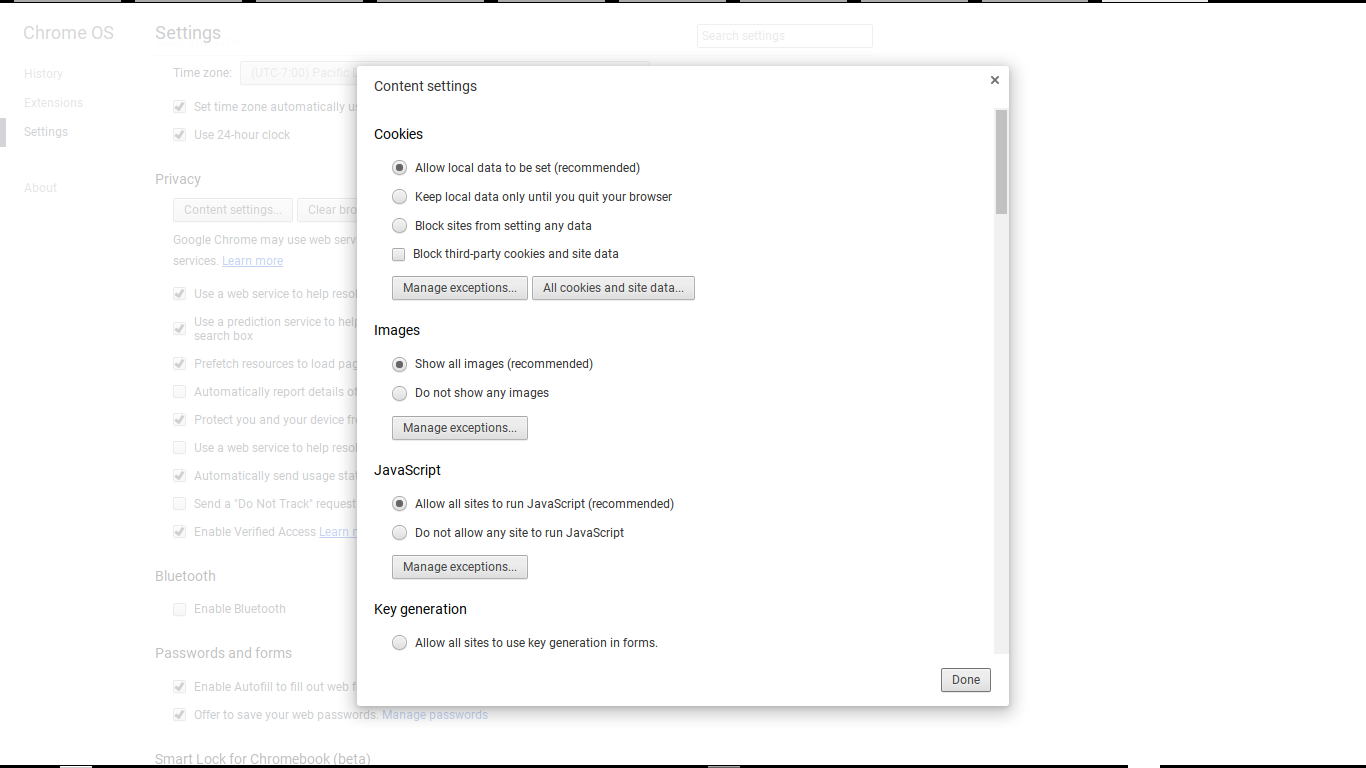
Start with the "Content settings" wizard.


Select "Block third-party cookies and site data", and / or "Do not allow any site to run JavaScript".


Add cookie exceptions, for specific websites.


Click on "Manage exceptions" under Cookies, to get the "Cookie and site data exceptions" wizard.


To add "google.com" as a cookie exception, paste / type "[*.]google.com", and select "Allow".


Click anywhere in the wizard window, to see the addition - then click "Done".


Add JavaScript exceptions, for specific websites.


Click on "Manage exceptions" under JavaScript, to get the "JavaScript exceptions" wizard.


To add "google.com" as a JavaScript exception, paste / type "[*.]google.com", and select "Allow".


Click anywhere in the wizard window, to see the addition - then click "Done".


Remember that cookie and script filter settings, in Chrome, may not be the only settings which you need to consider - and that many filters are subject to change, without your knowledge or approval.

For more detail about cookie and JavaScript exceptions, see Chrome Help: Manage exceptions. These are settings that you must determine and install - neither Blogger nor Google can make these changes for you.


Security conscious #Blogger blog owners may wish to ignore #Chrome recommendations, and block general permission for websites to install cookies and / or run scripts on their computers.

Some websites will not run properly, without cookies and scripts. If one is to use websites like Blogger and Google successfully, they need to be trusted - and Chrome must allow those websites to install cookies / run scripts.

Now, You See It - Now, You Don't

Some blog owners create a post, with content that should be visible, only when required.

The post contains a question - accompanied by the answer to the question. The question should be viewed, without the answer being visible, to make the reader think about the answer. This is called, by many, a "spoiler".

Not everybody knows how to construct a spoiler. Some blogs use JavaScript - painful to construct, and maybe not effective for every reader. Security conscious blog readers may block scripts from Blogger blogs - and either your spoiler is visible, immediately - or never becomes visible.

Neither of the latter scenarios make the post a lot of fun to read.

You don't need JavaScript, to make a spoiler.

This is fortunate, because not every reader is going to allow scripts, from every blog. Personally, I block JavaScript, in general - and enable only for my own blogs - and for specific websites, like the Blogger dashboard and most Google pages.

If the blog posts have a solid white background, you make the post text white.

Examine a post, in my text blog.


Two spoilers - both blank.


Click and drag across the first spoiler - and see the first answer.


Click and drag across the second spoiler - and see the second answer.


The spoiler code is not complicated.

What would YOU do?

What Lancelot chose is hidden. But - make <span style="font-weight:bold;">your</span> choice before peeking. To see the answer, highlight the area indicated, by clicking the mouse and dragging the cursor between the arrows.

The answer is here ==><span style="color: rgb(255, 255, 255);">Noble Lancelot said that he would allow <span style="font-weight:bold;">her</span> to make the choice herself. Upon hearing this, she announced that she would be beautiful all the time because he had respected her enough to let her be in charge of her own life.</span><==

Now - what is the moral to this story? To see the answer, highlight the area indicated.

The answer is here ==><span style="color: rgb(255, 255, 255);">If you don't let a woman have her own way, things are going to get <span style="font-weight:bold;">ugly</span>.</span>==

Hoping that your blog does not use a semi transparent floating background over a multi colour background, just make the text the same color as the background. Then, instruct the reader to click and drag the cursor, to highlight and make the spoiler visible.


A #Blogger blog post which contains a question and answer section is fun to read - but not every blog reader will benefit, with posts that use JavaScript, to hide text content.

An easy way to hide content is to make the text the color of the background. The reader can click and drag, to highlight the text, when then is visible.

http://blogging.nitecruzr.net/2011/10/cookies-vs-scripts-two-types-of-server.html

http://blogging.nitecruzr.net/2009/04/many-faces-of-google.html

</span>

Blogger Magic - Enabling Scripts, In Your Browser

Similar to the need to properly filter cookies in the browser, we have the need to properly filter scripts.

Cookies and scripts are completely different elements - but proper filtering of each is essential, to making many Blogger features operate properly.

If you have a problem with Blogger - either accessing / using the dashboard, or using / viewing a blog - one of the simplest things to check, complementing cookie filter settings, is the browser script filter settings.

The browser is the most important component, when setting up security - and scripts, like cookies, are a common challenge.

Script filters are adjusted differently, for each browser. Consider the multiple domains used by Blogger / Google - and layered security, on any computer, used by the owner and readers of any blog.

  • Chrome.
  • Firefox.
  • Edge / Internet Explorer.
  • Opera.
  • Safari.

Setting the script filters in Chrome.

With Chrome, you enable scripts, using Settings ("Customize and control Google Chrome") - aka the 3 bar toolbar icon.

In Settings, if necessary, click on "Show advanced settings" at the very bottom of the page.

Under Privacy, click on "Content settings", which gives you the "Content Settings" wizard. Here, you have selections for Cookies and Javascript - including "Manage exceptions" for each section. Select the recommendation.

  • JavaScript: Allow all sites to run JavaScript

Hit "Done" - and close the Settings tab.


From "Privacy", hit "Content settings".


Under "JavaScript", select "Allow all sites to run JavaScript (recommended)".


Alternately, you may select "Do not allow any site to run JavaScript" - then use "Manage exceptions", and allow all blog(s) that you publish, and the many Blogger and Google domains, to run JavaScript. Make your exceptions complete, for best results.

Setting the script filters in Firefox.

Firefox does not contain any native script filters. The most popular add-on for Firefox is NoScript - and this is how most Firefox users filter scripts.

You'll need to designate "blogger.com", "google.com", and any Google domain excepting "blogspot.com", as trusted - when you load any display for the domain in question. An untrusted domain will show a "NoScript Untrusted" icon in the status area at the bottom of the window. To enable each domain, you position the cursor over the NoScript icon and select "Allow (domain URL)" in the popup menu.

Setting the script filters in Edge / Internet Explorer.

With Internet Explorer, you enable security settings - both cookies and scripts - from the browser menu, using Tools - Internet Options. Optionally, you may access the "Internet Options" applet directly from the Windows Control Panel.

  • IE uses a zone defense setting, where you designate "blogger.com" and "google.com", in Security, as being in the Trusted zone. Please note that "blogspot.com", in general should not be in the Trusted zone - .
  • You will want the published URL of your blog(s) - including any country local domain URLs, in the Trusted zone.
  • Default settings for the Trusted zone will allow proper filtering of scripts.
  • Verify proper settings, with "Trusted sites" selected, and the Security level slider control set to "Medium". Hit "Custom level", and examine the Settings list.
  • Look for the "Scripting" section, 3/4 of the way to the bottom of the list.
  • You will observe 6 options under "Scripting". Default settings will have all options Enabled, except "Allow Programmatic clipboard access"; you may wish to Enable this to allow easy use of Post Editor.
  • Hit "OK", and "Yes" if necessary, then "OK" again.

Setting the script filters in Opera.

With Opera, you enable cookies and scripts from the Advanced tab, in the Preferences wizard. The Content menu contains selections for scripting.

Setting the script filters in Safari.

With Safari, you enable scripts, using the Preferences wizard. The Privacy wizard, in Preferences, contains selections for scripts ("Cookies and website data”).

Script filters cause problems with Stats "Don't track ..." and other Blogger features.

Many problems, reported in Blogger Help Forum: Get Help with an Issue, with various Blogger features - and the Blogger dashboard - involve script filters.

Stats and the "Don't track ..." option used to involve third party cookies, for many years. In March 2016, the "Don't track" wizard was rewritten to run under the URL of the blog, when being set - and now requires enabling scripts from the blog URL.

Consider how your blog is published.

If your blog is published to "blogspot.com", consider the non "blogspot.com" alias that may be relevant to your country. If your blog is published to a custom domain, consider the custom domain URL.

Many computers have other relevant settings, which block scripts.

Many blog owners and readers will have computers, and networks, with additional protection. Scripts, in the browser, may not be the only filter that needs to be checked - but this is a start, to learning how to control the script filters.

Having checked and corrected your script filters, continue by checking browser cookie filters - then check cookie and script filters, outside the browser. Also check settings on any ad blocker add-on - which may be an app, or a browser extension.

Be aware that many settings may not be obvious - and that both obvious and obscure settings may be updated, without your intention or knowledge.


Many #Blogger problems are cause by overly restrictive script filters. If you, a blog owner or reader, are going to use Blogger successfully, you need to configure your browser properly - for both cookies and scripts.

Stats "Don't Track" - You Cannot Satisfy Everybody

Blogger recently redesigned the Stats "Don't track ..." option - and removed third party cookies from the picture.

The "Don't track ..." wizard is now accessed from the blog URL. The wizard still produces cookies - but they are ordinary first party cookies, which are much less feared than third party cookies.

But, every silver lining has a cloud.

In making the "Don't track" wizard accessed under the blog URL, Blogger created a new requirement - which is no more understood, by some blog owners, than "third party" cookies.

"Don't track" now runs scripts from the blog URL, instead of the Blogger dashboard.

In order for a blog to observe - and preserve - the "Don't track" setting, any computer that the owner uses has to permit first party cookies - and all scripts - from the blog, instead of from the Blogger dashboard.

Since "Don't track" is designed to be used by the blog owner, this new requirement should not be a problem. Every blog owner should be able to trust herself / himself, to not add dodgy code to his / her own blog.

Many security products block scripts from personally owned blogs.

Unfortunately, general security practice is to block scripts from "blogspot.com", "blogspot.xx" (for every "xx" for every country local domain"), and preferably for blogs published to custom domains.

You can trust scripts from "blogger.com", and the Blogger dashboard. You cannot trust the individual blogs, since you cannot trust every blog owner. Even if you could trust some people not to intentionally try to hack your computer, you cannot trust everybody to not stupidly install malicious software from a very convincing hacker, providing one more "gotta have this" blog accessory.

And since you cannot trust the individual blogs, you will have filters. And those filters have to be adjusted, to trust your own blogs - if you want to ignore your own pageviews.

Some blog owners add security software, and don't know how to maintain the filters.

There are too many Blogger blog owners who have installed protective software on their personal computers - without knowing how to adjust the filters, in the protective software. And some of those owners think that it is a Blogger responsibility, to provide them instructions, how to adjust the protective software on their own computers - when only they are capable of knowing what they installed.


The new version of the Stats "Don't track" option is an improvement, because it no longer requires third party cookies - and involves the associated security risk. Unfortunately, it now requires blog owners to permit scripts, from the blogs themselves.

This is not a security risk, in that only personally owned blogs need to be trusted - but the blog owners do need to know how to adjust the filters involved. And not everybody with a computer knows how to configure their security accessories.

The New Stats "Don't track" Option, And Script Filters

The new Stats "Don't track" option is an improvement, to many blog owners.

"Manage tracking your own pageviews", as before, starts from the Stats dashboard page. The wizard now runs from a sub directory of the blog managed by the dashboard - and uses a normal (first party) cookie.

Now, blog owners no longer must enable third party cookies, to make Stats ignore their page views. This is an improvement - but it can still present a challenge, for some blog owners.

Besides filtering "third party" cookies, not all blog owners and readers will permit complete control by content under the individual blogs.

If you want "Don't track" to work reliably, enable scripts for the blog URL.

If you want the "Don't track" option to work reliably for your blog, you now must enable scripts to run under the published URL.

We have to trust scripts run from "blogger.com" - that is the Blogger dashboard. The Blogger dashboard is produced by Blogger Engineers - and if we trust Blogger to host our blogs, we have to trust their code.

Scripts which run under the individual blogs - "blogspot.com", local country domains, and custom domains - can be added by the owner of each individual blog. Not all blog owners should be trusted.

People who mistrust third party cookies may also mistrust scripts which run under "blogspot" etc. Unfortunately, to make "Manage tracking your own pageviews" work, you (the blog owner) now have to open up any script filters, which block content run as part of your blog.

Start from the Stats dashboard page.

Click on "Manage tracking your own pageviews".


"Manage tracking your own pageviews" now runs under the blog published URL. This removes "third party" cookies from the problem.

With a custom domain published blog, you must use the wizard in "HTTP:" mode.

By default, the new wizard runs in SSL mode. This will be a problem, with blogs published to custom domains.


If the blog is published to a custom domain, you will need to change "https" to "http".


Check "Don't track my views for this blog." - then close the tab / window.


The new wizard, "Would you like to have your pageviews counted when you visit this blog?", now runs as "blogging.nitecruzr.net", for this blog.

http://blogging.nitecruzr.net/b/statsCookieManage

If you publish to a custom domain, and you can correct the URL, you will see the same, for your blog. If you publish to "blogspot", you can see the same also. This is a script - and is subject to security filters.

And yes, there is no "Save" button, or link. Just the box.

Don't track my views for this blog.

Click the box or don't. As soon as you click, it's set.

You should trust your blog - even though you do not trust other blogs, in general.

Generally, as the blog owner, you can safely trust content run under your blog. You probably should not trust "blogspot.com", and all blog publishers, however. This means that you will require multiple filter rules - for every browser and security add-on, that contains a script filter.

  • Block all "blogspot.*". (Please!).
  • Permit "yourblog.blogspot.com".

If you publish to "blogspot.com", and live in a country which has a local domain, such as the UK, you need a rule to permit the local domain alias.

  • Permit "yourblog.blogspot.co.uk".

If you have multiple blogs - and want to block pageviews from being counted, for each blog, you need permissive filter rules for each blog.

  • Permit "yourblog1.blogspot.*".
  • Permit "yourblog2.blogspot.*".
  • etc.

If you publish your blog to a custom domain, you need a rule to permit the domain URL. For this blog, I need

  • Permit "blogging.nitecruzr.net".

If you do not permit the proper URL(s) for your blog, you will find Stats counting your own pageviews. Possibly, this will happen even with "Don't track my views for this blog." checked. In some cases, the check mark will be cleared, when you close the window.


Owners of #Blogger blogs who don't want their activity tracked by Stats now see a new "Don't track" wizard. Using the "Don't track" option no longer requires enabling third party cookies - and worrying about the security issues.

Unfortunately, this now means that the "Don't track" wizard may now be vulnerable to filters which restrict scripts that run under blogspot, and any custom domains.

McAfee WebAdvisor Blocks Blogger / Google Scripts

We have several blog owners, trying to use Blogger - and seeing warnings from McAfee WebAdvisor.
When I try to log out, I am getting a risky connection warning.
Whoa! Are you sure you want to go there?
I cannot log out of blogger.

The blog owner needs to log out from her current account.


"! Warning: Trouble ahead"

"Whoa! Are you sure you want to go there?"

This looks scary - but keep it in perspective.


If you're going to use Blogger / Google, you have to trust Blogger / Google.

Look carefully at the URL, in the advice. Is it a genuine Blogger / Google URL?

If you want to use Blogger - such as logging out so you can use a different account - you have to use the Blogger pages and scripts. You may have to instruct McAfee that you trust that URL.

You, and other McAfee customers, have to help train McAfee.

If you trust Blogger code - and as a Blogger blog publisher, you should - you need to train McAfee to not block Blogger code.

Start by clicking on "Accept the Risk", and follow instructions. Hopefully, that will send feedback to McAfee, informing them that they are reporting a false positive detection.

If you read the McAfee WebAdvisor instructions (wherever they may be), you may also find a site whitelist or similar filter setting - and you may need to add "blogger.com" and "google.com" to your whitelist. This, too, may provide feedback to McAfee.

This is one more episode in the Internet security process.

This is simply one more case of overly aggressive security. And that, like most general paranoia, is not necessarily bad - if you can keep it in proper perspective.

---

McAfee Webadvisor is currently advising blog owners, who try to logout from Blogger, that the logout webpage at "accounts.blogger.com" may be "risky". Since we know that Blogger Engineering is not going to intentionally cause risk for their customers, the McAfee warning is most likely a false positive - but the message, in the McAfee warning, will not leave people in a relaxed state of mind.

Blog owners may have to use the "Accept the Risk" button, and inform McAfee that they are displaying a false positive alert.

Stats And The "Don't track your own pageviews" Option On Mobile Computers

As mobile computing becomes more popular, we're starting to see questions about use of the Blogger dashboard on mobile computers (iPhone / iPod, PDA, smart phone), in Blogger Help Forum: Something Is Broken. Most recently, we're seeing people trying to use Stats, and the "Don't track my own pageviews" option, with Blogger on mobile computers.

Problems with Stats and the "Don't track ..." option are not unknown, in the past. We've helped many blog owners with this setting, which is sensitive to cookie and script filtering in general - and to "third party cookies" in particular. "Third party cookies" may be filtered in any of several places, any which will interfere with "Don't track ...".

The "Don't track ..." option, when seen as a problem with "full size" computers (desktop, laptop / notebook), may involve any of various "layered security" settings. In general "full size" computers use a somewhat standard software infrastructure. While any of several operating systems (Apple / Macintosh, Chrome, Linux, Microsoft Windows), and various browsers (Chrome, Firefox, Internet Explorer, Opera, Safari) make use of Blogger an occasional challenge on "full size" computers, there is some common features between the various operating systems and browsers.

With the various "operating systems" and browsers on mobile computers, we're seeing more discrepancies in features offered. In particular, not all "mobile computers" have explicit settings to allow / disallow "third party cookies" - or even cookies and scripts, in general. If these settings are not present, it's likely that these computers do not support such details as "third party cookies".

Without the availability of "third party cookies", Blogger can't support the "Don't track ..." option. Here, I'll note that this option is specific to each individual browser, on each individual computer. One must set the option - and browse the specific Blogger blog - using the same browser, for the option to work. This is not an option that can be set on a per user basis, and apply to all browsers used by a specific user.

>> Top

Contact Us

24x7 online , we happy to answer you
tamilcypc@gmail.com

Disclaimer

This Blog and its TUT's are intended for educational purposes only, no-one involved in the creation of this TuT may be held responsible for any illegal acts brought about by this Blog or TuT.


Featured Post

Custom Domains And HTTPS Redirection Code