Latest News

Showing posts with label Blog Title. Show all posts

Reader Zoom Level Affects Screen Space Needed

I have suggested that properly sizing the Jump Break and Title sections of each post is an important decision, when publishing a post in your blog.

Publishing this blog, using carefully sized post title and jump break sections, allows me to consistently publish posts, with maximum detail visible in main page view - and with the "Read more" link visible.

Potential readers may read a post in this blog - instead of returning to a SERP, and reading another blog. This affects a key reader retention metric, the "bounce rate".

All of that considered, sizing of the introductory post sections won't always produce predictable results.

Reader zoom level is a semi random factor, which makes blog section sizing less predictable than one would wish, when trying to increase reader retention.

I size my posts using "100%" zoom, in the Chrome browser. This may, or may not, produce the same effect, for readers using Edge / Internet Explorer, Firefox, or any other browser. And the differing browser will not be the only varying factor.

All of these details can affect zoom level, screen space requirements, and reader retention - for any different blog. Here it is helpful for the blog owner to know about the typical reader.

  • Display screen size.
  • Reader age.
  • Multi tasking activity.
  • Tech interest level.

Display screen size will affect how the blog sections look, to each reader.

Browser choice is not the only variation, that can affect screen space and blog section display sizes.

Reader display screen size used is a detail, that I cannot control. The computer on which I compose most posts has a 6" high screen. A second computer, that I use from time to time, has an 8" high screen. The second computer, even at a 125% zoom level, still displays more post content in one screen page.


This post (in main page view) displayed, at 100% zoom, on an 6" vertical display.


Let's compare this post, displayed at several zoom levels.

Here's this post, in the individual post page display - without Jump Break. See how it looks, zoomed in various font sizes. Note that here I use a maximised browser window, though some readers will resize the browser window to fit the blog content.
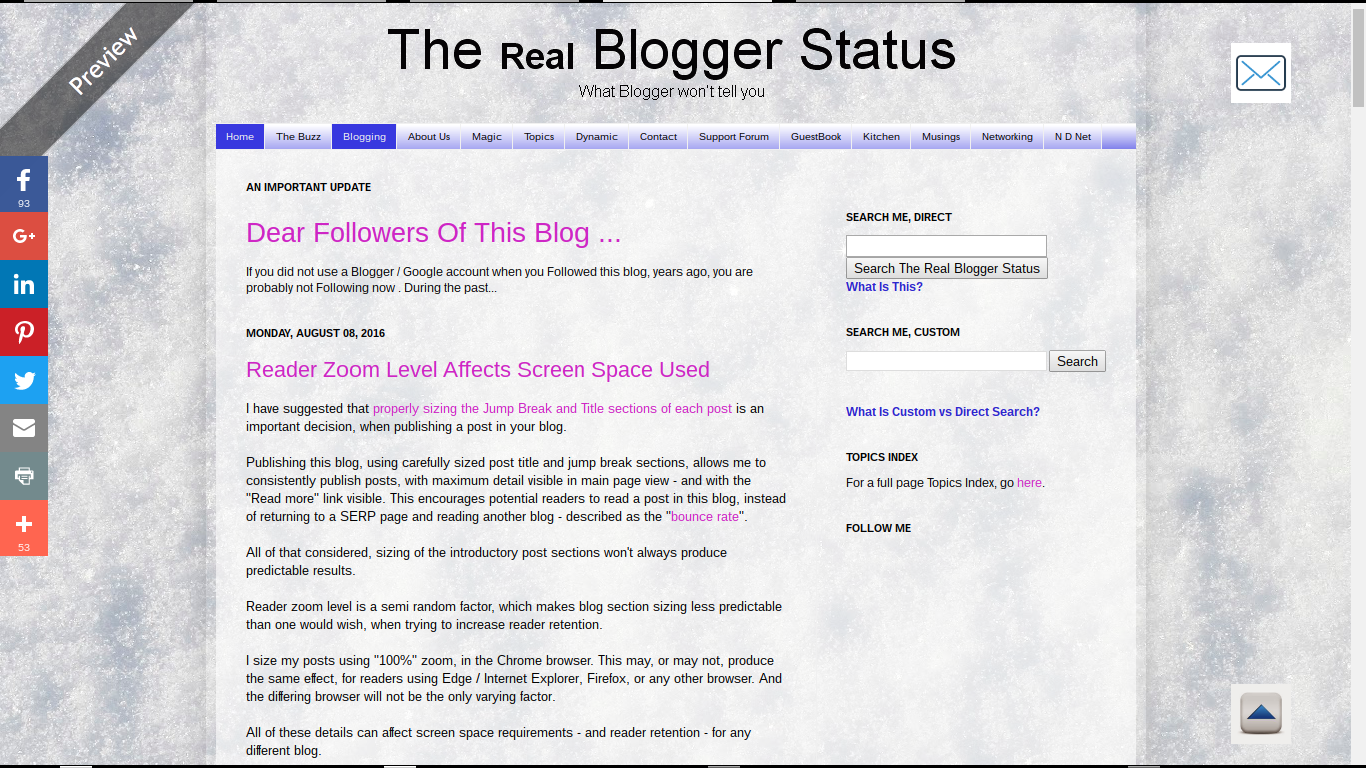

This post (in Preview mode) displayed, at 100% zoom, on an 6" vertical display.


This post (in Preview mode) displayed, at 100% zoom, on an 10" vertical display.


This post (in Preview mode) displayed, at 75% zoom level.


Smaller zoom is more likely to be used by people with better eyesight - using better resolution and more expensive computers, and smaller browser windows.


This post (in Preview mode) displayed, at 125% zoom level.


Larger zoom is more likely to be used by people with marginally worse eyesight. This will frequently involve older people.

Older readers will be more likely to use higher zoom levels.

Reader age is another detail which each blog author may consider, in blog design.

Blogs which attract older readers should be designed for displays which use higher zoom levels - or use larger fonts, to begin. Older readers, with marginal eyesight, will be more likely to surf the web with their browsers zoomed higher.

Multi tasking encourages smaller browser windows - and lower zoom levels.

Younger readers, who like to multi task, will probably use low zoom - and size the browser window smaller, so they can have multiple windows, simultaneously visible in large computer displays. Older readers will be more likely to focus on one task at a time - and will maximise the browser window, with higher zoom.

Blog subject may produce readers of differing age and tech interest.

Each blog, depending upon its content, may be more or less likely to interest readers of a given age and / or and tech interest level. People of different tech interest levels may also be more or less likely to use computers with higher resolution, and may multi task using smaller browser windows.

The bottom line.

Each blog owner will have to consider the various issues mentioned above - for each post published - and decide what screen sizes and zoom levels might be preferred by the target reader audience.

Only a blog owner can decide what reader audience may be more interested in each individual post - and may benefit from a specific zoom level. And this affects the proper sizing of the jump break and title section of each post.


Several details of a #Blogger blog audience affect what post title and jump break section will be more appropriate, for each individual blog. These details, in turn, can affect bounce rate / retention rate.

Wording The Blog Title And URL - Same or Unique?

Some blog owners setup a new blog - and want to know if the blog title and URL may - or (alternately) should - be the same.

There is no policy for Blogger, about blog title and URL - either that the "words" in each can, or cannot, be the same. Some SEO experts suggest benefits from having relevant words, in the URL - and some blog owners confuse this advice, as suggesting having identical titles and URLs.

Be wary of advice that references websites, in discussions about blogs. There are subtle, but real, differences between dynamic blogs, and static websites. Rules that may be important for websites may not be relevant, for blogs.

The most obvious differences, between blogs and websites, are found in content - but blog design may have similar differences.


SEO strategies, for a dynamic blog, and a static website, will be different. Dynamic blogs have many exciting opportunities.


I have suggested that it may not be possible to make the blog title and URL the same, in all cases.

  • Most subjects won't be unique. Many blogs will share a subject.
  • The blog URL must be unique. Two blogs cannot share a URL.
  • The blog URL will have restrictions, in characters allowed.

Most subjects won't be unique.

Any popular subject will have many blogs published to that subject. Every blog, about the same subject, will have a different URL.

If a blog is published, to a subject which has no competition, it will be a subject which interests nobody. A blog with no competition will likely have no readers.

The blog URL must be unique.

Two blogs cannot share a URL. One URL == one blog.

That does not mean that title and URL cannot share "words" - just that it's not possible that they will be identical, for all blogs.

There can be only so many ways to mention your favourite, top level movie star, in the title - and there will be even less ways to construct a unique URL. A less famous celebrity, on the other hand, will have less blogs to compete - and less readers also.

The blog URL will have restrictions, in characters allowed.

URLs can use only certain characters.

a sequence of characters beginning with a letter and followed by any combination of letters, digits, plus (+), period (.), or hyphen (-)

That syntax is somewhat limited, compared to characters that may be used in blog titles - and in the blog description and content. Less choice of syntax leads to less possibilities for uniqueness, while providing some clue as to the purpose of the blog.

A Blogger blog is dynamic - and you SEO using content.

Blogger blog content is dynamic. You get more performance, from a blog with regularly published, unique content, that's informative and interesting.

You get less performance, from imaginative naming strategies. Acme does not make an "SEO Kit", for Blogger blogs.


Some #Blogger blog owners worry about the need to publish a blog with the Title and URL containing the same words. Some suggest that having identical words is necessary, others that having identical words is not permitted.

Fortunately, neither possibility is relevant to Blogger / Google Content or TOS regulation. Blogger and Google care about content quality - and prohibit scraping and spam.

Blogger Magic - Changing The Blog Title

Some blog owners start a blog - then discover that they gave the blog the wrong name.

Unlike changing the Blog Name (Address), changing the Blog Name (Title) is not complicated.

You can change the title of a blog, any time you wish.

The blog name (title) is an important blog component. Changing the title is not difficult.

  1. Use the Blogger dashboard Settings - Basic page.
  2. Click the "Edit" link, next to "Title".
  3. Make the change, as necessary.
  4. Click "Save changes".


Go to the dashboard Settings - Basic page.


Click on "Edit", for "Title".


Make the change, as necessary. Click "Save changes".


The next post you publish will display the right title, in any search engine lists, and shares. If the blog uses FeedBurner, to distribute by email or provide improved newsfeed subscriptions, you may want to check the feed title also.

What effect will this have, on search engine content?

When you change the title, all of the existing posts will still be indexed, under the old title. All of the SERP entries will show the old title - and the blog will be searchable using the old title.

As the blog is re indexed, the search engines will pick up the new title. This won't happen, immediately, though.

And the people who find the blog, when searching on the old title - and click on a SERP entry referencing the blog - will see the blog with the new title.


The #Blogger blog title is a key blog component, which can be changed any time convenient. This is a very simple change - and can be done without planning.

Contact Us

24x7 online , we happy to answer you
tamilcypc@gmail.com

Disclaimer

This Blog and its TUT's are intended for educational purposes only, no-one involved in the creation of this TuT may be held responsible for any illegal acts brought about by this Blog or TuT.


Featured Post

Custom Domains And HTTPS Redirection Code